Structured data: what it is, how it works and why it matters
Structured data, schema markup and JSON-LD are not synonyms. Here is what each one is, why they are no longer enough to show FAQs on Google, and how to check yours.
In this article9
- What structured data is
- Structured data, schema markup and JSON-LD
- Why structured data matters for SEO and for generative AI
- The most common structured data types on a company site
- How to implement structured data on your site
- How to check that your structured data works
- Common mistakes when implementing structured data
- Frequently asked questions about structured data
- What to check on your site right now
You have been through Search Console and you can see that some competitor pages show up with stars, prices or expandable questions right under the title on Google, while yours do not. Or you searched for “structured data” to work out what it is and ran into articles about trees, linked lists and algorithms that have nothing to do with what you were after.
Structured data is in fact a far more specific thing: a standardised format for telling a crawler, whether it belongs to Google or to a generative AI assistant, exactly what each element on your page is, instead of leaving it to guess.
In this guide you will see what structured data is, how it differs from schema markup and from JSON-LD (three terms used as synonyms without quite being so), which types are most common on a company website, how to implement them and how to check that they work properly.
What structured data is
Structured data is a standardised format for describing the content of a page so that a machine understands it without ambiguity. On an ordinary page, a crawler has to infer what everything is: that the large bold text is a product name, that the number with a euro sign is the price, that those five stars are a rating. With structured data, that information is declared explicitly, in a format that follows a common vocabulary accepted by the main search engines.
Structured data vs. “data structures” (programming)
The two terms are easy to confuse because they sound alike, but they are unrelated. A “data structure” is a programming and data science concept: it refers to how information is organised in memory (lists, trees, hash tables) so that a program can process it efficiently. “Structured data”, in the context of SEO and GEO, is something else entirely: markup you add to your page’s HTML to describe its content to search engines and AI assistants. If you came here looking for the first one, this is not the article you need.
Structured data, schema markup and JSON-LD
How the three terms fit together
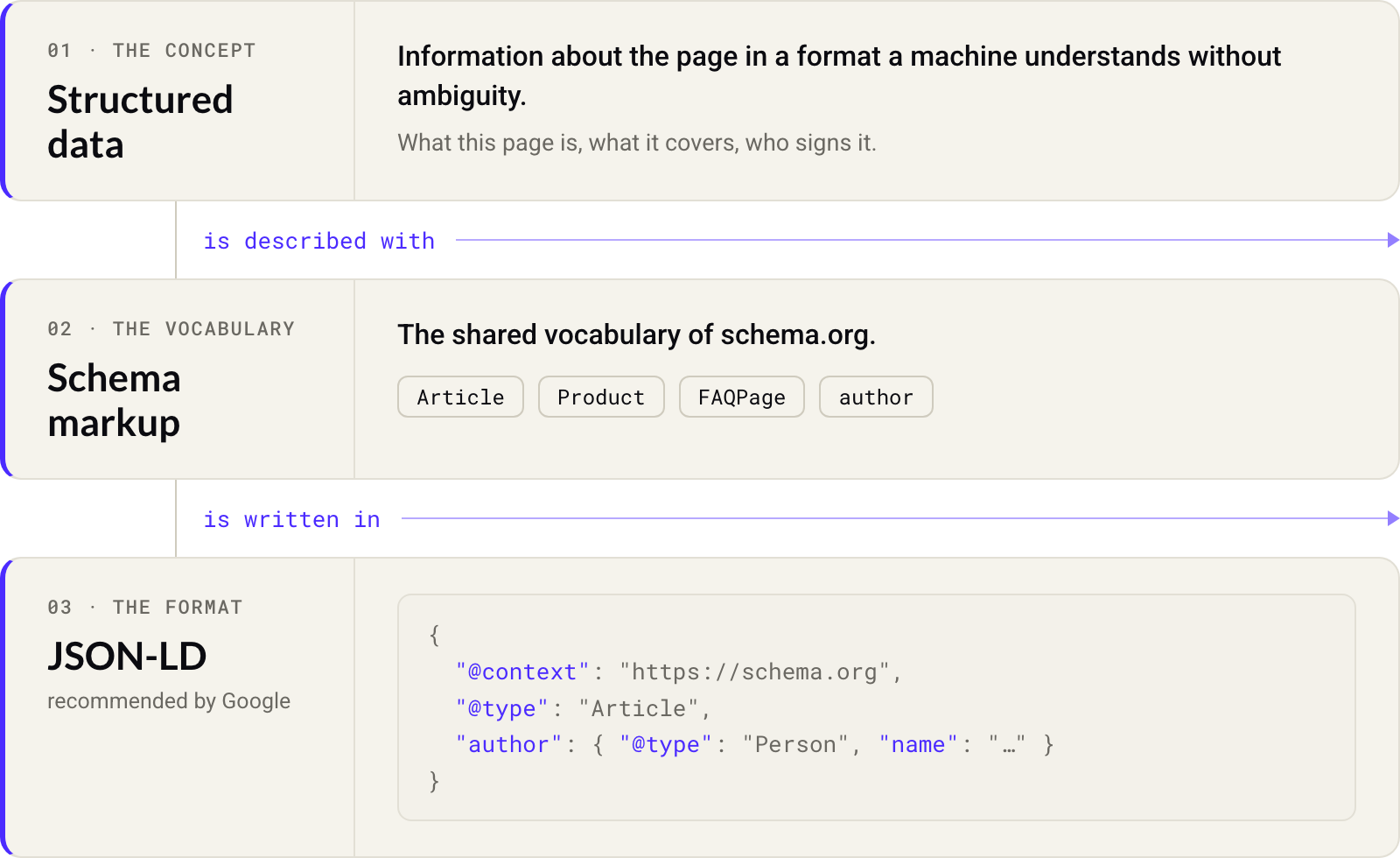
“Structured data” is the general concept. “Schema markup” and “JSON-LD” are two specific pieces within that concept, and they are often used as if they were synonyms for each other when they actually answer different questions: one is the vocabulary, the other is the format it is written in.
Schema markup: the vocabulary (schema.org)
Schema markup is the shared vocabulary that defines which kinds of things exist (an article, a product, an organisation, an event) and which properties each one has (a product has a price, an article has an author and a publication date). That vocabulary is maintained by schema.org, a joint initiative by Google, Microsoft, Yahoo and Yandex.
JSON-LD: the format Google recommends for writing it
Schema markup can be written in several formats: JSON-LD, microdata or RDFa. JSON-LD is a self-contained block of code, usually placed in the `head` or at the end of the `body`, that does not mix with the visible HTML of the page. Google recommends it explicitly because it is easier to generate, maintain and debug than the other two options.
Why structured data matters for SEO and for generative AI
Rich results in Google Search
The best-known reason to use structured data is to become eligible for a rich result: those review stars, the price of a product or the expandable FAQ block that sometimes appears under a Google result. But this needs an important, up-to-date qualification, confirmed directly in the official Google Search Central documentation (certainty level 1, primary source, updated on 7 May 2026): from that date, FAQ rich results are no longer shown in Google search results, on desktop or on mobile.
Google will also retire the corresponding Search Console report and Rich Results Test support in June 2026, and support through the Search Console API in August 2026.
This does not mean you should remove `FAQPage` markup if you already have it: the type is still valid in schema.org and Google confirms that keeping it causes no problem, it simply no longer produces that particular visual result in search. It is a relevant nuance, because part of the search volume on this topic still assumes that marking up FAQs guarantees that format, and since May 2026 that is no longer the case.
Readability for generative AI crawlers
Beyond rich results, structured data serves another purpose that has gained weight with the arrival of generative AI assistants: it helps a system such as ChatGPT, Perplexity or Gemini understand unambiguously what a page is about, without having to interpret the visual design or run JavaScript.
This matters especially because not all AI crawlers render content the way a browser does: some read the HTML they receive from the server directly, and there a well-built JSON-LD block states explicitly what the crawler would otherwise have to infer from the rest of the page.
That said, it is worth being honest about the limits of this: having structured data does not guarantee that an AI assistant will cite your site in its answers. It improves the readability of the page for these systems, but citation depends on many other factors (authority, how relevant the query is, whether the source is available at the moment the answer is generated) that no markup on its own can secure.
The most common structured data types on a company site
Not every schema markup type applies to every website. These are the most common ones on a company site:
| Type | What it is for |
|---|---|
| Article | Identifies a blog or news article: headline, author, publication date. |
| Product | Describes a product: name, price, availability, ratings. |
| Organization | Identifies the company: name, logo, social profiles, contact details. |
| BreadcrumbList | Marks up a page’s navigation path within the site. |
| LocalBusiness | Describes a business with a physical location: address, opening hours, phone number. |
| FAQPage | Marks up the questions and answers on a page. It no longer produces a rich result on Google as of May 2026, but it remains a valid type and useful for the general readability of the content. |
How to implement structured data on your site
JSON-LD, the recommended format
Here is what a basic Article structured data example looks like in JSON-LD:
<script type="application/ld+json">
{
  "@context": "https://schema.org",
  "@type": "Article",
  "headline": "Article headline",
  "author": {
    "@type": "Person",
    "name": "Author name"
  },
  "datePublished": "2026-08-01"
}
</script>
This block of code goes in the `head` or at the end of the `body` of the page, without mixing into the visible content. Just as a sitemap helps Google find your content, JSON-LD helps it be understood correctly once found.
Microdata and RDFa: why they are used less
Microdata and RDFa mark the data up directly inside the visible HTML tags, using attributes such as `itemscope` or `itemprop`. They work, but they have a practical drawback compared with JSON-LD: any change to the page design means touching the markup as well, because the two are interwoven with the visual HTML.
That is why Google recommends JSON-LD as the preferred format, and why most current plugins and generators use it by default.
Plugin vs. manual implementation
If your site runs on WordPress, plugins such as Yoast SEO or Rank Math automatically generate much of the basic schema markup (Article, Organization, BreadcrumbList) from the data you already have in the CMS. Shopify does something similar for types such as Product.
A manual implementation makes sense when you need a very specific type that the plugin does not cover, or when you want precise control over which properties are included.
How to check that your structured data works
Google’s main tool for this is the Rich Results Test, which replaced the old Structured Data Testing Tool (now discontinued) and shows specifically which rich results Google can generate from your markup.
If you need a more generic validation, focused on the schema.org vocabulary without the “what Google shows” filter, there is also the Schema Markup Validator, maintained by schema.org.
- Rich Results Test: validates specifically what Google can show as a rich result.
- Schema Markup Validator: validates the markup against the full schema.org vocabulary, without limiting itself to what Google accepts as a rich result.
Common mistakes when implementing structured data
- Marking up content that is not visible to the user on the page: Google treats this as a disallowed practice and may ignore the markup.
- Leaving required fields incomplete, such as a `Product` with no price or availability.
- Not revalidating the markup after a template or CMS change, which can break the JSON-LD without it showing at a glance.
- Duplicating the same `FAQPage` across several pages when the content repeats, instead of marking it up only once.
Many of these mistakes are not caught by reading the page visually, precisely because they depend on how a crawler actually reaches the HTML, including generative AI crawlers, which do not always run JavaScript the way a browser does.
A technical crawler accessibility diagnostic lets you spot these gaps before they affect visibility, both on Google and in AI assistants.
Frequently asked questions about structured data
What is structured data?
A standardised format for describing the content of a page so that a machine, whether a search engine or an AI assistant, understands it without ambiguity. It is not the same as a “data structure” in programming.
Are structured data and schema markup the same thing?
Not exactly. “Structured data” is the general concept, and “schema markup” is the specific vocabulary (defined at schema.org) used to create it.
What is JSON-LD and why does Google recommend it?
It is one of the formats for writing schema markup: a block of code separate from the visible HTML. Google recommends it because it is easier to generate and maintain than microdata or RDFa, which are mixed into the page design.
Does structured data guarantee that my page appears as a rich result?
No. Google does not guarantee that content with structured data will be shown as a rich result, even when the markup is correct. And since May 2026 some types, such as FAQPage, no longer produce a rich result at all, even though the markup is still valid.
Does structured data help ChatGPT or Perplexity cite my site?
It improves the readability of the page for these systems, by declaring explicitly what everything is. But there is no guarantee that this translates into a citation: it depends on many other factors that markup alone does not control.
How do you check a site’s structured data?
With Google’s Rich Results Test, to see what Google specifically can show, or with schema.org’s Schema Markup Validator, for a more general validation of the vocabulary.
What to check on your site right now
If you are not sure what structured data your site has right now, the first step is to run your main pages through the Rich Results Test and check for errors or incomplete fields. If you use `FAQPage`, you do not need to remove it: it is still valid, just bear in mind that since May 2026 it no longer produces the expandable block in Google search.
And if you want to go a step further and check not just the markup but how a crawler (including generative AI ones) actually reaches the rest of your page, you can check your site’s technical accessibility free of charge.